PAIRS Lab

Research

Our focus on

Physical AI

Physical AI refers to AI embedded in physical systems that perceive, reason about, learn from, and act in the real world through a continuous loop of sensing, decision-making, action, and feedback.

PAIRS Lab develops trustworthy and scalable Physical AI that operates safely and robustly, protects people, uses data and resources efficiently, and continually adapts to broader tasks. We address barriers to long-horizon, widespread deployment toward a human–machine ecosystem in which people and intelligent physical systems coexist, collaborate, and co-evolve.

↑ Research directions

01Operate under extremes

Robust Mobile Autonomy for Challenging and Safety-Critical Environments

Our laboratory focuses on robust mobile autonomy for challenging and safety-critical environments, including firefighting, disaster response, emergency rescue, and other extreme scenarios. These environments represent some of the most demanding yet impactful applications of robotics, where autonomous systems can reduce human exposure to danger, extend operational capabilities beyond human limits, and support faster and safer emergency response. However, smoke, darkness, heat, dynamic hazards, uncertain terrain, and sensor degradation can fundamentally challenge conventional robotic autonomy. While modular pipelines for perception, localization, planning, and control have been extensively studied, their performance often depends on reliable intermediate modules and predefined environmental assumptions. Our research explores learning-based and end-to-end autonomy, with emphasis on multimodal perception, robust representations, hazard-aware decision making, and policy learning. By integrating complementary sensing such as thermal imaging and radar, we aim to develop robotic systems that can operate safely, adaptively, and reliably in environments where conventional autonomy is most likely to fail.

Selected research and lab demonstrations

Published work and ongoing prototypes are identified separately, with original sources linked when available.
Real-world demo

2026

End-to-End Goal-Initialized Navigation

GUIDE learns directional awareness from depth and proprioceptive history, enabling a legged robot to navigate cluttered environments without continuous goal updates or prior maps.

Explore GUIDE
Adverse-weather demo

NeurIPS 2024

All-Weather 3D Occupancy with 4D Radar

RadarOcc uses 4D imaging radar to estimate dense 3D occupancy in adverse weather and lighting conditions where camera- and LiDAR-based perception can degrade.

Explore RadarOcc
Scene Flow
Segmentation
Ego-Motion

CVPR 2023 Highlight

4D Radar Scene Flow and Motion Understanding

Hidden Gems learns scene flow from sparse 4D radar through cross-modal supervision, supporting motion segmentation and ego-motion estimation in dynamic driving scenes.

Explore Hidden Gems
Fire rescue

Ongoing lab prototype · Not linked to a publication

FireNav: Hazard-Aware Navigation in Fire-ground Environment

FireNav combines controllable fire simulation with synchronized thermal and 4D radar observations to benchmark PointGoal Navigation, evaluating goal completion and collision avoidance alongside peak temperature and cumulative heat exposure.

Related outputs: [GUIDE · 2026] [HyperDet · 2026] [Wavelet Radar-Camera Fusion · 2026] [SCORE-DETR · CEA 2025] [Robust Spatial Perception · RSS Pioneers 2025] [RadarOcc · NeurIPS 2024] [Backdraft Forecasting · EAAI 2024] [RaTrack · ICRA 2024] [Hidden Gems · CVPR 2023] [All-Day UAV Tracking · TMC 2023] [RaFlow · RA-L 2022] [MRCF · TIE 2022] [Ad2Attack · ICRA 2022] [DCF Tracking Review · GRSM 2022] [Dynamic Regression · EAAI 2021] [ADTrack · ICRA 2021] [SRECF · TMM 2021] [MSCF · ICRA 2021] [AutoTrack · CVPR 2020] [Failure Recovery for UAV Tracking · IROS 2020] [DR2Track · IROS 2020] [Augmented Memory CF · IROS 2020]
↑ Research directions

02Sense motion and contact

Human Motion and Physical Interaction Sensing

Our research focuses on sensing and understanding human motion and the physical interactions between humans and their environments. We develop multimodal sensing systems that integrate millimeter-wave radar, vision, surface electromyography (sEMG), inertial sensing, and force sensing to capture body and hand movements, muscle activity, contact events, and interaction forces. Our work encompasses the entire technical pipeline, from synchronized multimodal data acquisition, sensor calibration, and dataset development to multimodal learning and real-time state estimation. We aim to derive informative representations of human actions, interaction states, and behavioral intent from heterogeneous sensor data.

By moving beyond motion-only representations, we seek to characterize the relationships among movement, muscle activation, physical contact, and force during human motion and dexterous manipulation. These physically grounded representations provide richer and more complete information about human behavior for robot manipulation learning, with broader applications in human–computer interaction and rehabilitation.

Selected research and lab demonstrations

Published work and ongoing prototypes are identified separately, with original sources linked when available.
Lab demonstration

Ongoing lab prototype · Not linked to a publication

Wrist-Worn Muscle-Activity Sensing

This lab demonstration shows a wrist-worn sensing setup collecting multichannel surface electromyography and inertial signals during hand gestures. The prototype supports our exploration of compact wearable measurements that connect muscle activation with motion and physical interaction.

Dataset demo

CVPR 2026

Multimodal Human Motion Capture and Mesh Reconstruction

M4Human synchronizes mmWave radar, RGB-D, and marker-based motion capture at scale, supporting radar-based reconstruction of articulated 3D human meshes.

Explore M4Human
Adverse-condition demo

SenSys 2025

Thermal Egocentric Hand Pose

ThermoHands captures articulated 3D hand motion from egocentric thermal images during object interactions, including conditions affected by darkness, glare, and handwear.

Explore ThermoHands
milliFlow human motion sensing research preview Research preview

ECCV 2024

mmWave Radar Human Motion Sensing

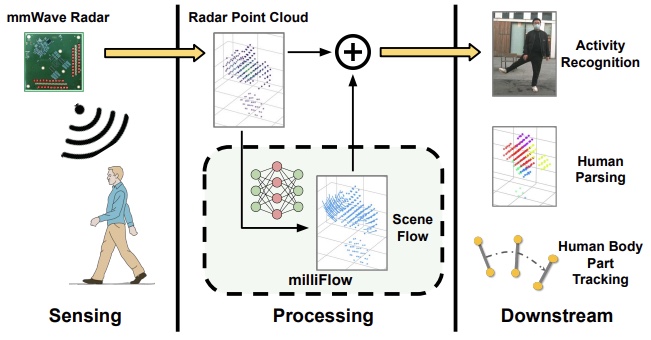
milliFlow estimates human scene flow from sparse mmWave radar point clouds, providing motion representations without relying on conventional visible-light imagery.

View milliFlow

Related outputs: [AI-based Motor Assessment · TNSRE 2026] [M4Human · CVPR 2026] [ThermoHands · SenSys 2025] [milliFlow · ECCV 2024]

↑ Research directions

03Remember and act

Long-Horizon and Memory-Aware Mobile Manipulation

Our research focuses on long-horizon and memory-aware mobile manipulation. We develop learning-based systems that integrate perception, memory, navigation, and manipulation to carry out complex, multi-step tasks over extended periods. Our work spans scene understanding, memory representation and retrieval, decision-making, policy learning, and real-world deployment. We aim to enable robots to preserve temporal context, track task progress, adapt to changing operating conditions, and use past observations and interactions to guide future actions.

Long-horizon execution is challenging under incomplete observations and changing scene configurations, where errors can accumulate across subtasks. Reactive policies that rely primarily on current observations often struggle to maintain coherent long-horizon behavior and recover from execution failures. We investigate memory-aware representations and policies that connect past experience and scene understanding with decisions over extended action sequences. By integrating perception, memory, navigation, and manipulation into a closed loop, we seek to develop reliable embodied agents that can operate robustly and adaptively in the real world.

Selected research and lab demonstrations

Published work and ongoing prototypes are identified separately, with original sources linked when available.
Real-robot demo

CVPR 2026

Progress-Aware Long-Horizon Manipulation

PALM combines structured affordance reasoning with continuous subtask progress estimation to maintain coherent behavior across multi-step manipulation tasks.

Explore PALM
Lab demonstration

Ongoing lab prototype · Not linked to a publication

Sequential Block Stacking with a Single Arm

This lab demonstration follows a single robotic arm as it places blocks in sequence. The setup provides a focused testbed for perception, action sequencing, task-state tracking, and reliable execution as we develop longer and more adaptive manipulation behaviors.

Related outputs: [PALM · CVPR 2026] [Dexterous Manipulation Survey · T-ASE 2025]

↑ Research directions

04Synthesize and scale

Scalable Robot Learning through Scene and Data Synthesis

Our research focuses on scalable robot learning through scene and data synthesis. By integrating 3D scene reconstruction, procedural generation, generative models, physics-based simulation, and motion planning, we construct diverse, interactive, and physically consistent virtual environments. Within these environments, we synthesize the visual observations, task specifications, action trajectories, and interaction feedback required for robot learning. Our research spans real-world scene digitization, simulation construction and randomization, task and behavior generation, synthetic-data quality assessment, policy learning, and sim-to-real transfer. We aim to transform limited real-world scenes and robot demonstrations into training environments and interaction data that can be systematically scaled across tasks, objects, and robot embodiments.

This research addresses the high cost of real-world robot data collection, the limited diversity of available environments and tasks, and the scarcity of long-tail interaction data. We investigate the relationships among scene semantics, physical properties, task objectives, and robot behavior. By closing the loop from real-world perception and scene synthesis to large-scale data generation, policy learning, and physical deployment, we seek to improve generalization to unseen objects, environments, and tasks. This research provides scalable data and environment infrastructure for general-purpose robotic manipulation, embodied intelligence, and robot foundation models.

Selected research and lab demonstrations

Published work and ongoing prototypes are identified separately, with original sources linked when available.
Physics-aware generation

2026

Seeking Physics in Diffusion Noise

Seeking Physics uncovers physical-plausibility signals in intermediate diffusion features, then uses a lightweight verifier to select and guide denoising trajectories toward more physically consistent generated videos.

Explore Seeking Physics
Generation demo

ECCV 2026

Camera-Conditioned Radar Data Generation

RadarGen synthesizes automotive radar point clouds from multi-view cameras while preserving geometry, motion, and occlusion structure, illustrating a data-generation pipeline grounded in real scenes.

Explore RadarGen

Related outputs: [Physion-Eval · 2026] [Seeking Physics in Diffusion Noise · 2026] [RadarGen · ECCV 2026] [APTO · ASP-DAC 2025]